
Bilge pump wiring woes

DoctorOctopus

Well-Known Member
Joined
May 10, 2020
Messages
89
Reaction score
10
Points
8
Age
58
Location
Far Rockaway, NY
Model
Seafarer
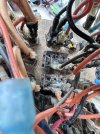
Anyone know how a Grady aft bilge is normally wired ? I have no idea where my auto wire goes. It disappears into a conduit

ImHaving issues and can’t figure it out

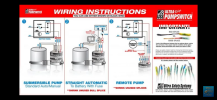
I wired up the new one and it works on manual but not automatic automatic gives me an odd low half voltage 3-4V. I tested the auto wire and I am getting 11-12v vs battery negative

I wired the new one … straight forward black to black. Brown to brown pump and manual a switch. Then red to auto (brown and yellow wire rust disappears into a conduit and goes somewhere in the boat I cannot find. Not the switch panel. ). The pump has a green power light that is on.

My switch panel is a on/off spst with a light and fuse.

Can I just wire the auto from the switch to the battery. ? Or will I have problems when turning on manual under way. (Panel is wired to battery switch )

Power light on the switch is on. And it works on manual. But not when I invert itIMG_4966.png
 

Attachments

  • IMG_4970.jpeg
    IMG_4970.jpeg
    1.6 MB · Views: 5
Last edited:
Is this an auto sense type of pump?

I think the auto lead should be connected to a battery via an inline fuse, The wire that disappears may be the one that goes to the battery. You need to find its fuse which by code should be close to the battery it runs off of.
When you find that fuse, test that the feed is good. A multimeter may not tell you since they draw very small currents. A test lamp is abetter tool to see if there is a problem Of course when you locate the in line fuse, you should open it and look for a blown fuse or a corroded fuse holder. Follow the wiring back to where it connects to the battery. That might be the positive battery terminal or the battery feed to the battery switches. The pump feed would then be connected to the feed side not one of the switched terminals.
 
Was the original switch an Auto/manual? My Grady and many others only had a Manual switch. The "auto" float switch was fed from a battery. It may have connected at the battery switch COM terminal so it would not get shut off when the battery switch was off.

There was a blade fuse holder from battery power to float switch. The other float switch wire splices to the brown pump wire.

I don't understand the necessity of an Auto/Manual bilge switch.
 
Check owners manual on GW site. It's likely a brown/black wire coming out of the harness. Check connection to the bilge pump - the accessory switch may have broken off.

This is an on/off not an auto/manual but I suppose it could be looked at that way (off position being auto). The accessory manual bilge pump switch on the panel has a light in it. This indicator light tells me that the auto bilge floats switch is "active". If it stays on too long I get concerned.

There is an inline fuse near the batteries that protect the power to the bilge pumps. This circuit is not switched off so you always have bilge pump power.


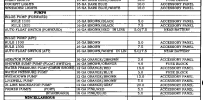
Bilge Pump Wiring.png
 
Was the original switch an Auto/manual? My Grady and many others only had a Manual switch. The "auto" float switch was fed from a battery. It may have connected at the battery switch COM terminal so it would not get shut off when the battery switch was off.

There was a blade fuse holder from battery power to float switch. The other float switch wire splices to the brown pump wire.

I don't understand the necessity of an Auto/Manual bilge switch.
The auto/manual function is there to provide pump out of the bilge when the auto function doesn't work when it should.
Manually activating the bilge pump and observing how long if at all water is pumped out can alert yo to the situation where the auto activation may have failed (and there is abnormal water in the bilge)
 
The auto/manual function is there to provide pump out of the bilge when the auto function doesn't work when it should.
Manually activating the bilge pump and observing how long if at all water is pumped out can alert yo to the situation where the auto activation may have failed (and there is abnormal water in the bilge)
Yeh....Thats obvious.... But you don't need a switch position for auto