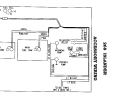

Bilge Wiring Diagram - 1999 Bimini 306 - adding a bilge alarm

IFish4Tuna

Well-Known Member
Joined
Apr 12, 2005
Messages
123
Reaction score
34
Points
28
Location
York Harbor, ME
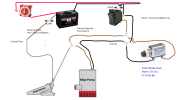
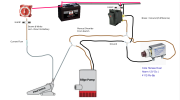
Just passing this image along for others to reference. It took me a while to trace out the as built. I ended up splicing the alarm in up at the console area using double blade femail connectors instead of the 3way crimps as shown in the image. My new insurance company requires a bilge alarm which I should have done long ago.

Works great.
BilgeAlarmWiring.png
 
what insurance company do you use?

Your solution has a flaw as I see it. If your float switch gets stuck in the down position, has a broken wire, or your bilge fuse blows, your pump won't work and neither will your alarm. A separate system with its own power feed and water level sensor is a better approach.

If your switch is intender to be the manual pump switch, it normally would be connected to the accessory buss. and therefore not powered when the battery switch is off.
 
I think this is a good idea, regardless of the insurance company.

It looks like your manual switch is connected direct to the battery - it should really be connected to switched power so it can't accidentally be left or bumped on. Granted, the way you have it, when you manually turn the switch on it appears the alarm will sound - but if the alarm craps out, you wouldn't know if the switch is left on. Best practice is to have manually controlled items always connected downstream of the load side of the battery switch.

Along with that, having the alarm on it's own, dedicated circuit (as noted above) is really the best way to do it.

It all functions and works just fine the way you have it - just some thoughts to tweak it to make it better/more reliable.
 
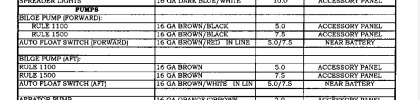
This is GW standard wiring for my 268 Islander. I'm not sure the bilge pump wires to the battery switch are on the switched side of the switch (on hot side). This way the bilge pump can't be turned off. The bilge pump is fused for safety. The brown wire goes into the wiring harness and goes forward to the panel at the helm. There it is connected to a circuit breaker and manual bilge aft bilge switch. This brown wire at the helm gives you a visual indicator that the pump is running and could easily be tied into an alarm.

On my boat I installed a separate high water alarm circuit with float switch and large bell.
Screenshot 2026-04-13 at 8.38.36 AM.png

Screenshot 2026-04-13 at 8.45.51 AM.png
 
Thanks for the comments.

Yes my console switch is controlled by the battery switch, and the float switch goes direct to battery. I should have drawn the line to the switch, not to the battery. Have 2 battery banks and 3 batteries. Console is fed by switch 1.

Insurance company Markel American

Yes I also thought about a 2nd float and alarm just for the alarming, but I opted against it for simplicity. Also the boat has a forward bilge so it would have to have double failure to fail to pump, but may not alarm. Now that I know how to wire it, I could always add an alarm to the front also..Screenshot 2026-04-13 154643.png

Here is the revised image.
 
I have been watching this and am not sure what the purpose is. As I see it the alarm only tells you voltage has been sent to the pump, but does not give indication of high water level or if the pump is actually pumping. Am I wrong?
 
The problem with GW's is that you may not know you are taking water on. It's hidden under the deck. It takes a lot of water to affect the handling and attitude of the boat. You need to get ahead of the problem.

High water alarms should be independent of the bilge pump. If the bilge pump float switch fails in the above diagram you won't have a bilge pump or an alarm. You need a separate alarm that sounds if the bilge water gets too high. I rely on the console bilge indicator lights all the time to see if the bilge pump comes on and eventually goes off. When I put the boat up on plane the thin layer of bilge water runs aft and triggers the bilge pump . occasionally my high water alarm will go off. At least I know the high water alarm it's working.
 
  • Like
Reactions: IFish4Tuna
I have been watching this and am not sure what the purpose is. As I see it the alarm only tells you voltage has been sent to the pump, but does not give indication of high water level or if the pump is actually pumping. Am I wrong?
Correct. But it at least "complains" to let you know there's some sort of issue - at which time one could further investigate.
 
Well I am in it now. As I see it this is not an alarm, but a sound indicator that the system has been energized by either the manual switch or the automatic float switch. The only alarm or failure indicator would be no sound when manually energizing via the switch to test or use the system. Float switch failure would be the same, silence, but who looks at that while running. My manual helm switch has a led indicator which provides same function with no additional wires. That said a high water alarm would be nice. My boat is on a lift from late August till late November while I am up north. A wifi high water alarm would be nice, any suggestions or ideas.