Replacing generator with inverter on 330 Express

I’d like to do this to my 330 but I want the AC to run off it. I’m thinking I need about 600 ah of batteries and a proper inverter/charger. I’d love to hear any input you guys may have on specifics like inverter size/model, etc
 
I’d like to do this to my 330 but I want the AC to run off it. I’m thinking I need about 600 ah of batteries and a proper inverter/charger. I’d love to hear any input you guys may have on specifics like inverter size/model, etc

I tried running my AC off my setup and I was observing about 1100 watts steady state (as I recall). My 2000 watt Mastervolt inverter seemed to run it just fine. If you assume 90% efficiency then the actual DC amperage for 1100 watts should be about 100 amps. With my motors running they were supplying about 60 amps, so the battery draw is about 40 amps when the compressor is running.
 
I dont think this is an issue because Alternator output is still connected to the cranking batteries. Issues would occur if there was no place for the output to go.
The issues is the low resistance in the lithium battery will suck the current out of the alternator at a rate it cannot handle. DC to DC is a must for lithium unless you can install a different voltage regulator (inboards have this option)
 
The issues is the low resistance in the lithium battery will suck the current out of the alternator at a rate it cannot handle. DC to DC is a must for lithium unless you can install a different voltage regulator (inboards have this option)
That makes no sense. The Lifepo battery isn't sucking the current. It is accepting the current. And doing it efficiently without resistance. It has been my understanding folks use DC/DC chargers in RV setups where the RV's alternator puts out a lot of current (i.e. one might be capable of 120amps) and the Lifepo battery can only be charged at 100amps. DC/DC charger would regulate that down to a level acceptable for the BMS.
 
Last edited:
So I did a ton of research on this, and the issue is twofold: (1) some (but not all alternators) can burn out when supplying too much current. The issue is that they were designed to charge a lead-acid battery which will not accept the high level of current an lithium battery will. More sophisticated alternators don't have this problem however. (2) Lithium batteries typically come with a built-in battery management system which can instantly disconnect the battery in certain error conditions, such as overheating. Apparently the sudden disconnect of the load can also damage alternators.

For these reasons, both the battery manufacturers and inverter makers strongly recommend using a DC-DC charger in between an alternator and a lithium battery. I spoke directly to tech-support at Victron and they confirmed this recommendation.

But just to complicate matters further, some outboards, in particular Yamaha, do not use automotive-style alternators at all. On my motors (4.2L F250's), DC current is created by fixed magnets on the fly-wheel rotating past "lighting" coils. My understanding is that the Yamaha systems generating a constant amount of current depending on the RPM of the engine and they simply sink any unused current to ground through a water cooled shunt. So I don't believe there's anything that can be burned out. As for what can happen if the battery is suddenly disconnected, I'm a lot less certain. I'm definitely unwilling to risk damage to the engine, though, since I do some pretty far offshore trips and engine reliability is the most important thing to me.

 
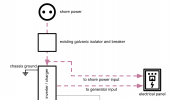
Minor Update: I rewired the system last season so that inverter/charger is no longer in-line with the shore power system. Instead it's output goes to where the generator output used to go (see diagram). The reason is that my particular unit had this annoying feature that even if the unit was on standby, as soon as AC power was available it turned itself on and if power then went out, it would begin inverting running down the battery bank. So if someone disconnected my shore power, I'd end up fully depleting the battery bank which would be bad for it.


1700676982181.png
 
  • Like
Reactions: Chutch
Bumping this thread to see if folks have any updated reports / configurations. Would love to drop in a LiFePo house battery and 2000w inverter to power AC on my Marlin while trolling offshore.

Just a ton of conflicting info out there as to need for Orion units from each starting battery vs direct Aux charge cable.

For those that have an AGM house bank + inverter, how long are you able to run AC at trolling speeds? When the bank gets depleted by inverter, do your electronics go out or are those wired to starting battery?
 
  • Like
Reactions: mg1826
Coming from a guy that is not averse to risk, I would not run a LiPo direct off your engines unless they are Mercs blessed by Merc to run lithium.
I put in a lot of time on the subject to determine if it would be an issue. It likely wouldn't, but there are a lot of variables the average Joe can't test for that should be properly vetted. Merc charging systems are not the same as Yamaha, Suzuki, etc. IMO I'd rather spend a few bucks on a DC to DC charger rather than wonder why my engines won't start with a storm rolling in, or have to pay big bucks to fix a fried charging system that was over taxed. Worst case for me is Suzuki says it's ok to run them directly off the engines. At that point I might remove the charger(s) and recoup ½ of my cost on flea-bay.
As for the electronics, I would not run them off starting batteries. If you are worried about the AC running your bank down too far and losing power to the house, I would consider you buy a LiPo battery with a BMS that allows you to shut the battery down before it is fully depleted or provides a notification on your phone.
I'm not running AC off my LiPo set-up, but I'm very happy with the result and would tell you to not be afraid to run that type of battery. The info provided via app on your phone gives great transparency to your state of charge and battery health. The significantly lower weight can (in some cases) provide a performance benefit, but at the very least the batteries will be much easier to move around.
 
The original OEM AC on my 2003 30 Express consumers about 1100 watts when the compressor is running. So the quick math is 1100watts divided by 12 volts = 91.67 amps, but inverters are only about 90% efficient so the actual 12v amperage consumption should be about 100 amps. At idle / trolling speeds, my motors supply about 50 amps (as measured from my clamp ampmeter) so the batteries have to supply the rest. I have about 150 amp hours of capacity in my small AGM battery bank so I should be able to get about 3 hours. Note that assumes the compressor is running 100% of the time. If it's not that hot and it's running just 50% of the time then I'd get 6 hours.

If/when I switch to LiPo's I'll probably add DC/DC chargers unless I can fully verify that batteries are OK without.