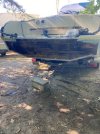
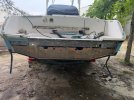
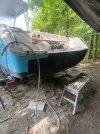
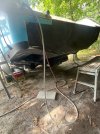
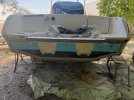
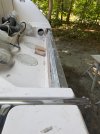
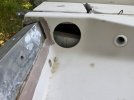
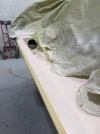
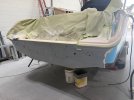
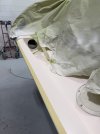
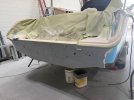
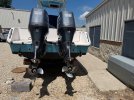
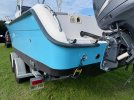
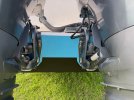
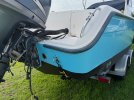
1997 Islander 268 Transom Rebuild Project

Thanks for brining us along. Gives me some confidence if/when my 2007 gets there.

What is 'petrified plywood'?

Tx, Rob
The section of the transom below the aluminum bracket are where the stringers are attached. The transom was 2 pieces of 3/4" marine plywood. The wet resin soaks into the plywood and several layers of fiberglass material are overlaid. When they opened the transom up the two layers of 3/4" plywood was wet, had turned black and practically fell out. That resin preserved a thin layer of the plywood that still has a healthy wood color to it.

That layer of fiberglass and the aluminum will be cleaned up and re-used.
 
Last edited:
  • Like
Reactions: wahoo33417
I'm disappointed with Grady White with their transom design at least on the pre-2000 boats. Euro transom in particular but all plywood transoms are fair game. Everyone blames the "bang cap" and thinks that if it's caulked and not corroded life is good! The fiberglass cover for lack of a better term in front of the transom in the splash well has numerous screws in it. You may be able to keep the splash well waterproof for 30 years. But the transom top extends out to both sides under the top/bottom half of the boat at the rub rail. The crap they fill with is brittle and doesn't adhere well. It's impossible to prevent the top/bottom half of the boat and the rub rail dry underneath.

After reviewing my transom here is what I found. The 1 1/2" Plywood in my transom was wet and delaminated. The aluminum bracket was secured properly to the stringers. The bracket saved my boat - top Motor bolts went into aluminum bracket. This would prevent the motors from tearing out at the vertical edges (hopefully!).

For the re-build the aluminum bracket is a big concern. Bonding to aluminum is a big problem. Oxidation. Aluminum etch is recommended to prep. West Systems has a special epoxy - G\Flex - that is the right stuff at least to attach the Coosa board.
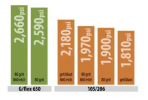
Screenshot 2026-07-15 at 10.16.09 PM.pngG/flex® 650 is a toughened, versatile, liquid epoxy for permanent waterproof bonding of fiberglass, ceramics, metals, plastics, and damp and difficult-to-bond woods. It is a bit more flexible than standard epoxies and polyester but much stiffer than adhesive sealants. This gives it the ability to make structural bonds that can absorb the stress of expansion, contraction, shock, and vibration. It is ideal for bonding dissimilar materials.

 
Last edited:
Transom is back together. Next is the finish work.

The transom is three pieces of Coosa board 3/4”, 1/2” and 1/2” laminated with glass and resin. Laminated to 3/8” x 2" x 8" aluminum L-bracket with West System G/Flex epoxy and glass.

Old splashwell trim and bang cap will be eliminated. Glassed over for seamless finish.


Rotted Wood.jpeg Rotted Wood 2.jpeg Cleaned out.jpeg Coosa 3.jpeg Coosa 2.jpeg

Reinstalled.jpeg Bang CAP.jpeg Splashwell.jpeg No more bang cap.jpeg Skin back on.jpeg
 
Last edited:
Transom moving along. Full Coosa Board Bluewater 26 transom. 3/4"+1/2"+1/2" laminate. West System G/Flex epoxy laminate to aluminum. Eliminated "bang cap". Will be finished up this week. Done by Signature Fiberglass in Ocean View, NJ. They know their stuff and will work with you to get you what you want!

No more bang cap.jpeg Skin back on.jpeg
 
Project finished! I'll add a photo of the splashwell when the motor harness is hooked up. AwlCraft 2000 paint is amazing! That finish is out of the spray gun - not sanded or buffed. Hasn’t been sealed yet either.

Final 1.jpeg Final 2.jpeg Final 3.jpeg Final 4.jpeg
 
Last edited:
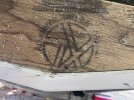
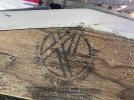
So here's the Grand Finale on the transom. When my glass guys stripped the "skin" off the transom they took this picture for me. Rotated and blown up you can read "XL", "Lifetime Warranty", "quality audited".

Quick check with Google AI: This is "Greenwood XL" that GW used in 1997. Typical latent defect claim. Warranty only covers material - nothing else. GW will say it's not their fault. But don't worry...it's nothing that can't be fixed for about $12,000.

Rotted Wood 2.jpeg

Greenwood XL marine plywood (often branded as XL or XL-50) features a specialized pressure-treatment and waterproof glue formulation designed to resist fungal decay, rot, and insects. It carries a manufacturer-backed limited lifetime or 50-year warranty against rot, though coverage typically applies only to replacement of the raw wood material and excludes fiberglass, epoxy, or labor costs.

Quality Audit & Performance
    • Core Construction: Manufactured with void-free inner plies and weather-and-boil-proof (WBP) bonding agents to stop moisture infiltration from the inside out.
    • Treatment Process: Uses a specialized pressure-treatment that alters the wood cell structure rather than standard off-the-shelf treatments, minimizing leaching.
    • Field Longevity: Widely adopted by prominent boat and pontoon builders (such as Grady-White and Bennington) for transoms, stringers, and deck panels with high historical success.

Warranty Scope & Limitations
    • What is Covered: Structural failure or fungal rot of the Greenwood XL plywood panel itself.
    • What is Excluded: Labor, fiberglass delamination repair, gelcoat work, secondary hardware damage, or costs to tear down and reinstall the panel.
    • Transferability: Varies by the original boat or vehicle manufacturer; some brands permit transfer to a second owner within a specific initial window (e.g., first 10 years), while the raw wood guarantee relies on the original Greenwood Forest Products specification guideline.
 
Last edited: